PT
ES
AO
CV
MZ
Professional
Executive
Public Sector
Omnia
Evolution
Cegid Pulse consists of a set of intelligent capabilities called Smart Tools, natively integrated into the ERP to support companies' day-to-day management.
The main goal of the Smart Tools is to increase productivity, reduce operational errors, and support faster, more informed decision-making, turning the ERP's data and processes into relevant actions and insights for the business.
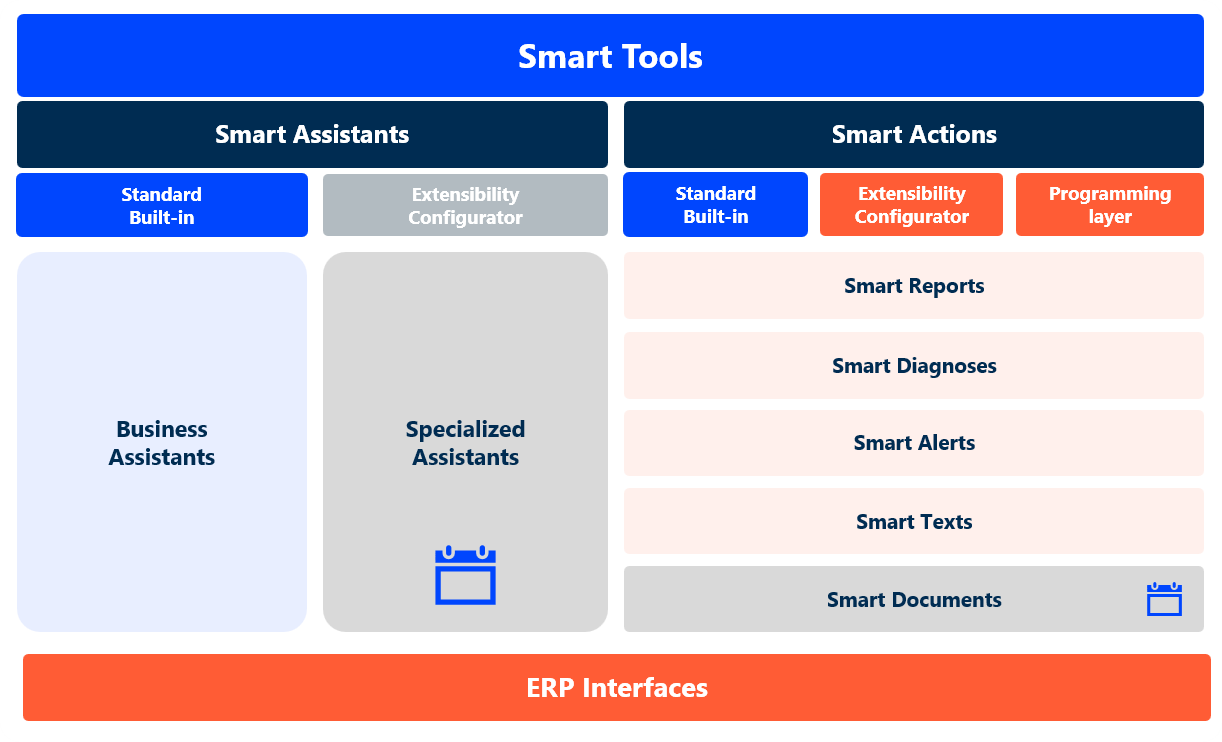
As shown in the diagram, the Smart Tools are organized into two main, complementary categories: Smart Assistants and Smart Actions.
Smart Assistants
Smart Assistants are conversational agents that let you interact with company data using natural language.
Instead of navigating through multiple screens or reports, users can ask the system questions directly and get contextualized answers, analyses, and recommendations that make information easier to understand and support decision-making.
There are two approaches:
Standard Built-in
Assistants provided natively in the solution, designed to meet users' common needs.
These assistants cover more cross-cutting business areas, such as sales, accounting, or operations, and are designed to let companies quickly start interacting with artificial intelligence and take advantage of its benefits, simply and immediately.
Extensibility Configurator (coming soon)
A configuration mechanism that lets you create or adapt assistants for each organization's specific scenarios, making the experience better suited to their processes and goals (using low-code).
Smart Actions
Smart Actions represent the execution-oriented layer of intelligence.
While Smart Assistants help interpret and understand information, Smart Actions let the system act on that information, integrating artificial intelligence directly into the ERP's workflows.
These capabilities can be triggered by the user or work proactively, identifying relevant situations, suggesting actions, or automating tasks.
Examples of Smart Actions include:
Smart Reports – intelligent generation and enrichment of reports.
Smart Diagnoses – automatic analysis of situations and identification of potential issues or opportunities.
Smart Alerts – monitoring and proactive notifications about relevant events.
Smart Texts – automatic creation, improvement, or adaptation of text content.
Smart Documents – intelligent processing, interpretation, and generation of documents (coming soon).
There are three main approaches:
Standard Built-in
Smart Actions provided natively in the solution, designed to meet users' common needs.
Extensibility Configurator
A configuration mechanism that lets you create or adapt Smart Actions for each organization's specific scenarios, making the experience better suited to their processes and goals (using low-code).
Programming Layer
A configuration mechanism that lets you develop fully customized Smart Actions, tailored to specific needs through extensibility.